
It seems that 2013 is shaping up to be the season I finally get around to trying all the things I’ve been meaning to try!
(ok, so there are still a million other things I want to try, but we’re making progress anyway…)
😆
Yet another system I’ve wanted to test is of course the “Worm Tower“. It’s a very simple idea, but it has always appealed to me since it can be an effective way to employ the “power” of composting worms directly in your gardens.
I recently created 5 towers from a single 10 ft length of 4″ diam. perforated PVC sewer pipe (plus caps). I would have preferred something a bit wider than 4″, but larger sizes don’t seem to be readily available (and those that are seem to be considerably more expensive). The one nice thing about this size, though, is that I definitely don’t need to worry about taking up too much space – one potential downfall of my “Verm-fertilization & Watering System“.
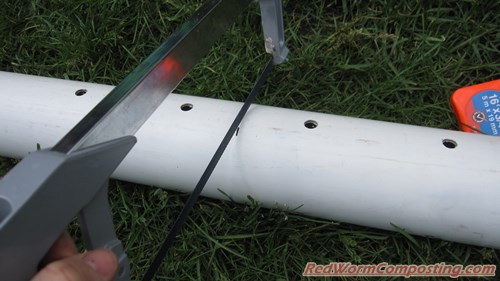
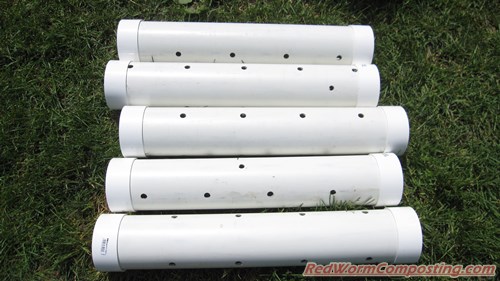
I really like the size of the holes in this type of pipe, but I was a little bummed to see that there were only a couple of rows of them. As such, if you decide to use the same pipe, my recommendation would be to drill some additional holes – at least if you want plant roots to be able to access the tube from all sides.
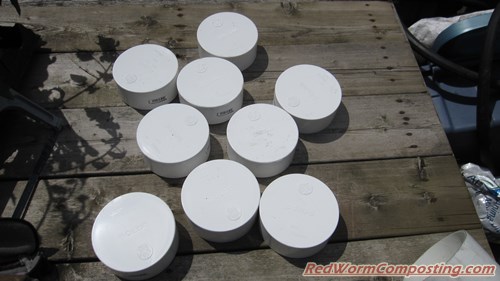
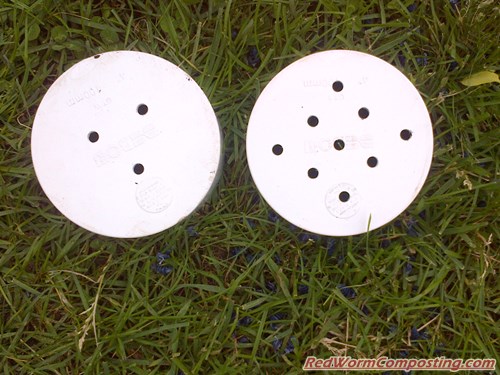
Apart from drilling some more holes in the pipe (I’ve only installed one tower so far), I also drilled some in the caps. Similar to my Vermi-Fertilization System, I want some rain water to get in so as to help keep things moist. One note of caution – if you happen to use a similar type of cap, you may want to put it on very loosely. As I discovered, these caps can be very difficult to get off if you give them too much of a thump putting them on. Perhaps something like Vaseline around the inside rim would help to remedy this?
I decided to place my first tower in between a couple of my tomato plants to see if it would have a positive impact on their growth.
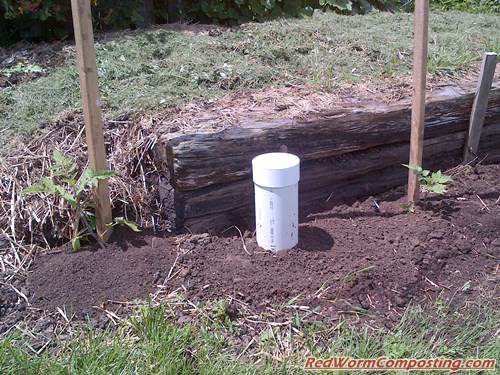
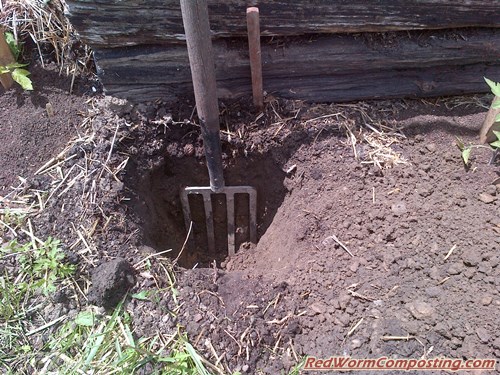
I started by digging my hole. I didn’t go too crazy with, but it was deep enough so that more than half of the pipe ended up submerged (as you can see in the first image above).
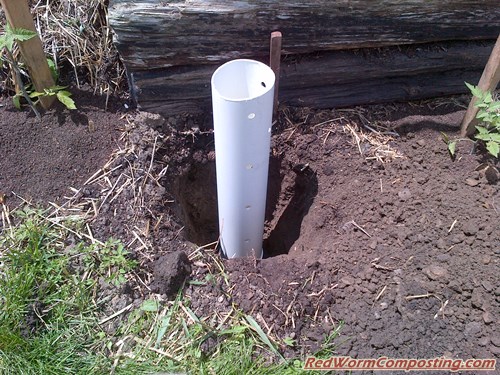
As I did with the vermi-fertilization bin, I filled the space around the pipe with aged horse manure. This was actually material from worm beds (most of the adult worms harvested), so there are plenty of juveniles and cocoons already in there. I also filled the pipe partially with the mix.
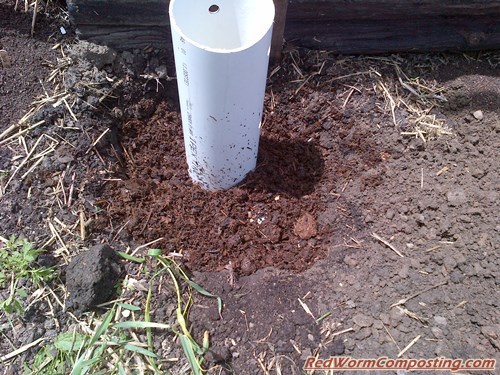
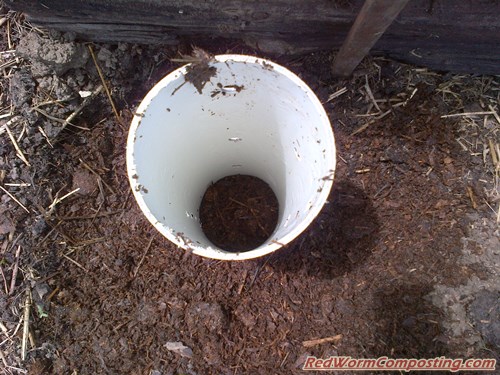
Lastly, I added a layer of soil over top of the outer manure layer and put the cap on.
I didn’t actually add any food waste when setting the tower up, but will likely do so today.
One down, 4 more to go!
I’ll be sure to keep everyone posted on my progress.
How long did you make the towers?
What is the length of the pipe? Some reason I feel garbage can is too big and 4″ pvc pipe is small.. lolz such an imperfect world. Let’s find something in between. But PVC might work too. Thanks for great idea…
Fred
Do you put caps on both ends?
Sorry for delay approving comments (not even sure why I need to keep approving yours, John!) .
John/Fred – The pipes are just shy of 2 feet in length (compensates for flared end which I didn’t use). In hindsight, I could have created with 6 towers (from a 10 ft pipe) and ended up with a better length. These ones seem a wee bit long for my liking. I agree 4″ does seem a bit narrow, but it encourages me to help the worms along by really chopping up the materials going in – otherwise, it will fill up in no time!
Chris – yes caps on both ends. Others seem to leave their towers open at the bottom, but I’d prefer to be able to remove the unit with everything inside when it comes time to do so.
Bentley,
A girl “down under” did something like that sometime back. She made a short video. Enjoy.
http://www.youtube.com/watch?v=scUTrypzyY0
Bentley, any follow up to how this worked for you? I’m interested in trying this and was hoping for some feedback. It seems like most posts I read are very soon after they initially “plant” their worm towers. But I rarely see any follow-up.
Thanks!
I have used worm towers for some years. Love them! I use pipe of 25cm diameter top. That’s the same size opening as my scrap bucket in the kitchen, so I don’t make a mess tipping in the scraps. My family of 7 can keep up with 3 towers and a worm farm pretty easily. Any smaller would be frustrating I think.
I use 50cm long PVC pipes and bury the lot. There are different types of worm, living at different depts in the ground. I want to encourage them all to visit me.
I start a new worm tower with about a litre of castings (with worms) from my worm farm and I crack a raw egg over the top. Having composting worms helps compost faster. After that, I just add contents of my kitchen scrap bucket. Other varieties of worms will move in over time. Also, a raw egg seems to encourage them to breed. 🙂
I put in ANYTHING!!! Weeds from the garden go in, and fill the space quickly. All kitchen scraps. Newspaper from cleaning the budgie’s cage. The last family hair cut. Excess egg cartons. Being in the ground, if the worms don’t like what I’ve put in, they’ll move next door – the surrounding soil! In the past I’ve even added a significant amount of citrus peelings. I checked a few weeks later – that tower had more worms than the next one. Clearly they left when they didn’t like it, and returned when they were brave enough. You CAN”T do this in a sealed worm farm. I’ve learned that lesson often enough!
I cover my towers with a plant pot base and a brick. Our local crows are clever and have learned to take the lid off if not weighed down. I don’t cap the bottom. When I think it’s time, when the tower looks mostly full and well processed, I just dig out the contents with a trowel. That precious valuable stuff goes into plant pots or around fruiting trees (under mulch of course, to keep the beneficial bacteria moist and alive.)
I like to have a worm tower near each fruit tree. They are in the one place for many years, and would surely benefit from the ongoing nutrition provided by the worms and compost. Also, the tower provides a great way to water the tree. A lot of what goes in the tower is moist, and often I add more water to serve as a liquid fertiliser for the tree. At times I’ve filled the tower to full, but not often, as I don’t want the worms to drown.
I’ve recently planted some fruit trees in pots. I’m eager to try narrower towers in the pots to see if they work in that situation.