
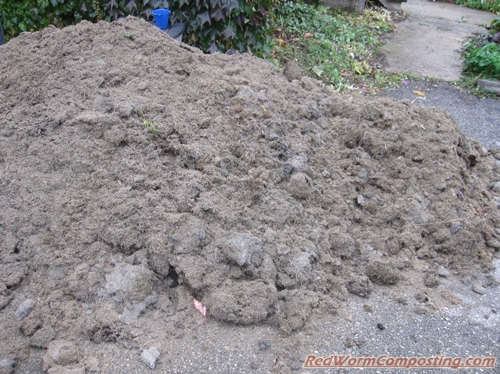
Right next to my son’s daycare center there is a lawn bowling club. For quite a few months there has been a big heap of old grass clippings and thatch sitting up against the fence in one corner. It has been rare for me to walk past and NOT think about how that would serve as a great worm food or “living material”. (You know you’re a “Worm-Head” when…lol)
This morning I happened to notice my friend Theo – who volunteers at the club – milling about, so I asked if they had any plans for the material (letting him know I’d be more than happy to take it off their hands). Not only did he say I was more than welcome to it, but he even offered to load it into his trailer and then drop it off at my house.
Sweet!
So now I have what looks to be more than 1 cubic yard of the stuff sitting on my driveway. The material will be great for covering my outdoor beds – but I also want to test it out in my Mega. My hunch is that the worms will go gaga for it once it’s sufficiently moistened.
Stay tuned!
😎
I have used dried grass clipping often and the worms do like them. Since I work at a school with a large playing field there are plenty of clippings regularly. We take the clippings, dry them out on a home-made rack system (taking them from a “green” to a “brown”) then add them into the bins as needed. They are thoroughly spritzed as we add them in. Anything we can’t process, we dump into the back 40 for the “local” worms to enjoy.
Are dried grass clippings preferred to fresh, green clippings? I always thought that fresher, green grass clippings produced more nitrogen…is that untrue?
I do know that composting worms digest bacteria, not the ‘food scraps’ we feed them. So is that why brown (not fresh green) clippings are more readily digested by worms?
I love and appreciate your website!!! You are one of the few in my life that are passionate about our worms!
Thanks for sharing your passion and knowledge,
Theresa