
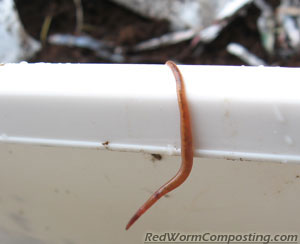
This is probably just about the MOST common vermicomposting question out there! I’ve had quite a few people inquiring about this just in the past week alone – so it’s definitely time I dedicated a post to the topic!
Let’s first talk about the word “escape”, since it is a crucial factor when it comes to evaluating the situation. If your worms are indeed trying to literally escape from your worm bins – especially when doing so en masse – you definitely have a serious problem that needs to be addressed right away.
If on the other hand you have a handful of worms crawling up the sides and lid of the bin, with perhaps a few dummies ending up dried up on your floor – you are probably ok! Especially if your system is brand new.
I would wager to say that when worms are added to a brand new vermicomposting system – especially after being shipped – they are far more likely to wander a little, than to completely settle in right away! Consider the fact that they are 1) being introduced to a completely new environment, and 2) have been in motion for at least a couple of days prior to being added to the bin/bed.
Worms raised by worm farmers on a large-scale basis will typically be kept in giant, open beds, and will commonly be fed some sort of manure. They are NOT kept in a million Rubbermaid tubs and fed food scraps – I can tell you that much for sure!
😆
SO…
When they are introduced to this totally new environment (the enclosed plastic bin), it’s not too surprising that they are a little restless for the first little while! How you set up your system can have a major impact on the situation as well. I recommend setting the bin up at least week before the worms arrive, so they are at least have a microbially active habitat. You can take this a step further by actually adding some compost inoculum (compost from another worm system would work well), or aged manure if you happen to have either of these. Even some leaf litter (decomposing leaves, found at the bottom of an outdoor leaf heap or on a forest floor) could help a lot.
Aside from preparing the best habitat possible, you can also take some steps to help keep your worms down in the bedding once they’ve been introduced to the sytem. If it is possible for you to shine a light over top of the bin for a few days straight that would be great (use a fluorescent or LED light to save power usage). Something that has also worked for me is adding a LOT of dry, absorbent bedding at the top of the system (generally more applicable for enclosed, plastic systems) – this helps to keep the sides and underside of the lid really dry, thus discouraging the worms from roaming up there.
I can remember back to when I received my very first European Nightcrawler shipment. They were very restless for the first little while, and I actually lost some due to them crawling out and falling onto the floor. When I added a bunch of dry bedding to the top of the bin, it worked very well! The worms stayed down where it was moist, and I didn’t lose any more.
Generally, after a few days (probably no longer than a week at the most) the worms should be quite used to their new home. If you are using the light technique I’d recommend turning the light off for short periods of time to see what happens – start with 10, 15, 20 minutes and go from there if they seem to be staying down.
How do I know if there is indeed a serious problem?
Trust me – you WILL KNOW!
🙂
If the worms are all balled up together in various spots in the bin, or in the handles (in the case of Rubbermaid-type bins), or they are escaping via every possible route you’ve made available (even the smallest air holes), then it is likely more than just being unsettled and needing time to get used to their habitat. Almost certainly, something you have added in the bin is causing them harm.
If you are using potting soil (something I definitely don’t recommend) for example – this can sometimes contain inorganic fertilizer salts which can really harm your worms. Even though these mixes typically contain a lot of peat moss (a good worm bedding), I prefer to steer clear of them altogether. Other types of bedding might cause issues as well – for example, some white office paper can contain irritating or harmful compounds (bleach etc). I recall back when I was still pretty new to vermicomposting, I set up a big bin using only white shredded paper as bedding, and the worms were NOT impressed. This paper can be used in moderation (and some paper is totally fine), but it’s better to err on the side of caution in my opinion.
Of course, the ‘food’ material in the system is very often going to be the culprit – if there is a LOT of waste materials, and not enough oxygen this can lead to serious issues, as can having too much N-rich waste (eg. grass clippings).
If your worms seem to be extremely stressed out, I would recommend a major overhaul of your system. Set up another bin using lots of moistened bedding (shredded cardboard) and any good rotting material you can get your hands on (leaves, compost etc), and transfer as many worms over as you can. You may not need to chuck out the contents of the first system (assuming the issue isn’t a nasty chemical of some sort), since these things tend to work themselves out over time.
Anyway, hopefully this post will help to put some minds at ease! In my experience, most of the time there is nothing to worry about when worms are crawling up the sides etc. As I like to tell people – it’s like ‘survival of the fittest’. All the ‘dummies’ and ‘weaklings’ manage to kill themselves off early, so your population then consists of the most tolerant, healthy worms. Any worms hatched into the new system will be even MORE tolerant and adapted to live in that environment!
8)
Hi. I started my worm farm about a year ago, the bottom layer filled up nicely, so i added the second tray and that’s when it all started to go wrong! All of my worms eventually vacated the top layer and headed down to the very bottom where the worm tea is collected. The worm tea ended up very thick and gluggy like mud. Just checked today and we have no worms in our bin, they are all down the bottom. What should we do?? We didn’t add anything different to what had previoulsy worked for us. Thanks
I am in the countryside of North Texas near red river. I am maintaining 2 compost piles outside adding greenery ie. Leaves limbs . Will red worms facilitate this or will I be wasting my time and $$. Any suggestions?? Thanks Kirk
Really helpful exchanges here, but I don’t see my problem shared by anyone. I have a “worm farm” vermiculture bin–one of those multi-layered tray things. Everything has been going great for the past two years until today, clumps of worms escaping–but the last time I added food and a little extra shredded paper was Sunday, and things were fine Mon and Tues (today is Wed), so I don’t think those have caused the problem. (there is still food there on the top layer; spinach, veggie and fruit leftovers mostly). I’ve got the lights on for now which is keeping them inside, but I think there are just too many worms in the farm, it’s a victim of its own success. Is that possibly right? I’m planning to harvest the bottom tray start and a new tray to put on top even tho the current top tray isn’t fully decomposed. My question is: what to do with the compost in October?? The rule is that you shouldn’t fertilize in the fall in the northeast, but rather do so in the spring. But if I harvest the vermicompost now, will it just lose all its nutrients over the winter?
Hi, bought some night crawlers about a week ago, all seemed to be going well, none were trying to escape, then 2 days ago I decided to bring them inside our laundry as it was getting too hot outside, I also game them some carrots, weet bix, which I just spread over the top, after a while I opened the lid and a few were on the bed surface, I just thought they were eating, but now all of a sudden they are trying to escape, any help would be greatly appreciated, thanks
For Kirk
Adding earthworms will help, but not red wigglers, they are specifically for indoor composting and feed only on food scraps. Earthworms may help break down brown and green outdoor matter. But you have to make sure your “green to brown” ratio–nitrogen to carbon–is balanced, it should be about 70% brown/carbon (mostly leaves, finely shredded wood, though that takes longer to decompose). Sometimes I buy “compost starter” which has the organisms needed to break down outdoor matter, but generally a few shovefuls of already composted material will be sufficient.
Brett, no idea what night crawlers are; if they are the same as red wiggler worms, the most common worm for indoor composting, making sure that the material is damp but not wet, and that you have enough food but not too much, is key. But changes of environment disorient them regardless, so push them back into the bin, leave a light on, and make sure that the dampness is right and the nitrogen is not too high (too much food).
I got back from a week long vacation to find 25 red wiggler worms on my floor shriveled up, my bin is new and its all newspaper. Should I put in some leaves and peat moss to balance the paper out. I also haven’t feed them. Should I feed them.
Is it okay to put used coffee grounds in my worm bin?
I did not do what you suggested by establishing the ecosystem prior to adding worms. My family and I went fishing, so instead of discarding the surplus of Euro Night Crawlers I unveiled a vermi-compost bin I made years prior….yes, a durable Rubbermaid bin.
Here’s what I observed over the days after our fishing trip.
I monitored them during the day (with Rubbermaid lid off) and none were trying to escape. It’s in the mornings that I have the issue.
It seems that they’re not trying to escape in broad daylight (with lid left off). Overnight, however, I think they are making their way to the top of the bin. In the morning their would be about 5-7 of them on our tiled floor (almost dried out).
It did help a bit when I layered the top with moist corrugated cardboard. They just rise to the top and hang out just under the cardboard.
And TC….yes, it’s okay to put your used coffee grounds in there. In fact, it’s recommend considering that the gritty texture helps the worms digest the scraps.
I’ll be checking back…my kinda community here. Take care, ladies and gents.
I am having trouble with finding worms and soil on my collection tray. When I set up my first tray, I only put about 2 sheets of newspaper on the bottom. Could the worms be escaping through that? Should I set up another tray with more sheets on the bottom and transfer them over?
My worms are trying to get out of a new bin… Peat moss and paper where as other 2 I have are more rabbit manure and straw… Anyone have issues with peatmoss?? Seems to be dry?!?!
Please HELP me! We had -6 Celsius/26 degreees F over here in Germany and the soil of my wurm tower was frozen. So I pulled the wurm bin into the house and now it is getting too warm and there is a massave escape going on. So I pulled all the worms out the bin and put them in a bucket with soil, fruit and wet card board and STILL they are “running” away. What can I do? Outside it is too cold, inside the house too warm… I will try the trick with the light and cold bottle now. Any other advice for me? Thanks, Kim
Just set my chalet up a week ago. Worms and chalet came as a kit so I had to set it up and add worms in a couple of hours. I need some help. When I took the lid off today to check them and feed there was a lot of water on the lid. To the point that it ran off in a stream. I dried the moisture off the lid and mixed some dry shredded newspaper into the bedding because the bedding when I squished it dripped water. When I was mixing in the paper I found two worm balls and I checked the bottom drain and there were some escapees in it. I havent been over feeding. I have fed them twice since I got them because I understand over feeding can be an issue until everything is established. Also every time I take off the lid there are always some worms sitting on the top. The whole thing smells earthy and I know that that is ok. Thanks so glad I found this site.
Nice article, thank you for the info. Ive had a four tier system going for 9 mons. Only emptied two trays so far. Recently I added some wood chips from my chicken coop and some very decomposed food scrapes. Since then I’ve had worms escaping every night. So the question is, ist the food sludge or the chicken wood chips that is making them want to escape? Many are stressed and balled up also, so something is not right. Any thoughts?
I’ve had my worm farm factory for 6 months now and this is the first time I’ve had a problem with worms escaping. This morning I found about two dozen on the floor. There were also quite a lot of them down in the drain bin. I haven’t changed the food, it’s been a mixture of chopped veggies, tea bags, coffee grinds, crushed egg shells, bananas, sweet potatoes, et. I also shred the cardboard rolls from paper towels and bathroom tissue and mix in to control the moisture. I have no idea why they were escaping. Towards evening I went out to check on them…..there were a lot up in the empty bin, again down in the drain bin. I don’t smell any odors and can’t figure out what’s going on. I took out the moist newspaper I leave on top and replaced it with shredded brown paper. I’ll see what tomorrow brings.
Those specks you are seeing in the worm bins are mites. They are not harmful and come and go. Adding shredded paper to the bin over the feeding bin helps to control this.
I received my worm farm yesterday and the worms as well. I have them in my garage (figured it is cool enough and not hot enough) so I thought it would be the best of all worlds for them. When I went in today just to make sure everything was good there had to be maybe 30 on the floor deceased. I’m hoping no more commit worm suicide. I think perhaps I need to put a light on now………..
Checked on my worms this evening. There were several large clusters just under the shredded paper. This is a sign of stress. Didn’t think it would be the temperature but I went ahead and put the gauge in to get a reading. (I keep my worm factory 360 out on my Lanai). This evening I checked on them and they were still bunched up and the temperature read 100 degrees! I brought them inside and checked again four hours later. There were about three that had escaped, but the temperature was down to 80 and the large clusters were not there anymore and there were fewer down on the worm ladder and in the drainage bin. I’ll leave them for a few days to calm down.
Thank you for posting this great article. My red wigglers arrive soon and I wanted to be prepared for any possible escapes before they happen. I will definitely be implementing your tips.
I know this post is a little old but I’m hoping someone can help us out. We have had our worms in our bin for about two months now and today when we went to feed them there were a lot crawling the sides AND tons of them balled up on both handles of the Rubbermaid container. Our bedding consists of coconut coir and is the consistency of a rung out sponge. My husband blends the food in a food processor before putting it in the bid. I believe he tries to make sure he doesn’t pour the food all over so the worms have a place to go where they wont be surrounded around by food. Any ideas as to what we can do to save our worms? We also added crushed eggshells for grit and a very small amount of soil for the bacteria two weeks before we added any worms at all.
I’m trying to figure out if my mass exodus last night is typical or indicative that there’s something really wrong with my setup:
Hi there! I started my worm bin a few months ago. Maybe because my worms came in the winter, they took a while to get acclimated. I only lost a couple stragglers every few days and they mostly stayed in the bin. However, I was definitely overfeeding and my worm population significantly decreased over the months. I decided to add new worms (now that I assumed I had my balance figured out), which I added last night. They were definitely very active when I put them in and immediately began crawling out. My bin has air holes in the top, so I put tape around the layer seam to block the easiest point of exit. I was shocked to come down this morning to a MASS exodus–I think almost 100 worms had crawled out, despite the tape!
I also keep cups of water around the legs of my bin to prevent ants and I found a worm ball in each cup of water. I was able to save those, but the dozens that were on the floor had dried up.
I have the Urbalive Vermicomposter (http://www.urbalive.com/vermicomposter). I put two lights directly shining on the seams before I went to work and while I still had some escape over the last few hours, the number has decreased. However, there still appears to be a worm trying every few minutes to make a run for it. I also looked at there’s a large worm ball in the center, beneath the layer of food and above the mesh that separates the food layer from the bottom drain.
So my question is: Is this the “mass exodus” people have referenced and I just need to patiently try to return as many escapees as possible? Or is the sheer number indicative that there must be something really wrong with my setup? I feel so bad that so many of these worms died, especially when I thought I figured out a good balance in my bin.
I use a 32litre flat plastic tub for tigers (fetida) and dendros (hortensis) for my wormery/compost. (Assorted plants – bell peppers, tomatoes, etc) I have had eggs & baby worms on the underside of the lid – condensation causes water droplets to hang underneath and the worms hatch out there and then chew their way through any grime on the underside of the lid. The white worms mentioned by several posters are probably baby worms. (They are small enough to pass through holes in the lid and the gap between lid and tub.) The red specks are probably mites and can be reduced by using the “melon-rind & rinse” technique. Earthworms “nightcrawlers” (Lumbricus terrestris) are generally garden worms rather than for wormery/composts as they have territorial burrows. My tigers/dendros only try to escape when I disturb them when using a fork to mix up the compost to break large clumps, etc. I use calcium carbonate powder and aquagel crystals (roughly a teaspoon of each sprinkled over and then mixed in). I use a mixture of papers (coloured scrunched and plain white shredded) and cardboard scrunched/shredded, and simply pour a cup of cold water over the paper once in the tub. The tub itself is resting in the bathtub – the coolest place in my flat – and gets shifted whenever I take a shower. (I put the plug in and run a little water to just cover the plughole, when the tub is in the bathtub.) The wormtea also drifts to the lower end of the tub. High humidity in flat as had rats (tails dropoff if too dry). I also deposit dead and waste from my other insect colonies – crickets, morios, mealworms. My experience has been reasonably plain-sailing – checked a host of websites for tips. (Posted as last entry was for 2015, with some questions still hanging…) My adult worms are about 20-30cm long. I try to make sure the food & water is in the tub and not nearby, and then any that do escape are likely to want to go back again rather than exploring. Plan to move to a layered tub system (with holes/tubes to connect them) in the future.
{edit} The rats were pet rats, and they need their tails for balance and climbing. 🙂
I read on somewhere someone tried vasoline treated with salt on the edge of the bin. Said it discouraged them from trying to get out. Would that kill them or would they have to be more exposed to the salt?
Jellis – I think that could work (although I have never tried it myself). I’m sure the worms would retreat long before they ended up with enough salt etc to actually kill them.
But as always, my recommendation is to put most of your focus on providing the worms with an ideal habitat and living conditions in general (although certain types of worms are just natural roamers).
how do I keep my worms when it real cold
Hi Mary – there are a variety of options. Unfortunately it is very challenging to keep a typical small-scale worm bin outside during winter (sub-freezing) weather. I highly recommend in-ground systems. Even a basic pit or trench with a lot of cover bedding can keep Red Worms alive in many locations (I am in Canada and have no trouble keeping them safe). Worse case scenario, a basic “insurance” bin (you can search for the topic here on the blog and learn all about it) is a great low-hassle way to keep worms alive during challenging times outside.
Great tips. It always takes a few weeks / months for a new worm farm system to stabilize. During this period, conditions fluctuate. And worms will move around until everything settles down. When there’s a lot of moisture / humidity, there’s always a few more worms around the lid. But nothing to be concerned about.
Weirdest thing. My bin has been going for a couple months and was going perfectly. Started with only about 250 large reds and I have just been adding small amounts of food for a while as there is more than enough room. I added some food the other day and I decided to also add a layer of bedding (finely shredded cardboard and coco coir) as well and this is when the exodus began. Just a couple dozen or so but they were not leaving the bin, just hanging around on top (except for one poor suxker who escaped through the bottom. I used the light method to push them down, and got rid of the new bedding, since it was the only new variable. The problem went a way for a couple days. Today again a dozen or so babies just hanging around up top. I noticed it was damp so I whiped all the moisture off the bin.
Hi Davis
There are various factors that can lead to these roaming/escaping worm situations. In your case I would wonder about temperatures and also about the coir. If this is sitting in an outdoor location, high temps might end up playing a role since the worms can really only handle up to about 94 F for any length of time. Even if ambient temps are lower than this, temps can easily be elevated inside of an enclosed bin – especially plastic systems, and even more so when exposed to sunlight. As far as the coir goes, this material can commonly have elevated salt levels. Worms are extremely sensitive to salts so this could lead to them trying to escape.